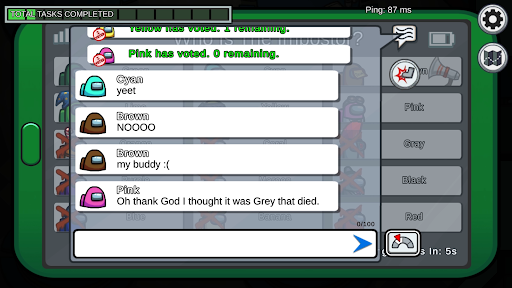
Among Us turns a tiny set of tasks and role assignments into accusations, alliances, and deception. Its Android build is strongest when played with a known group, because moderation and emotional pressure depend on who is in the lobby. Innersloth documents account-gated Quick and Free Chat controls, a reporting path, and a flat random chance for the Impostor role. Google Play also reports collection of device and user IDs, crash logs, purchase history, optional email, and optional user-generated content. Those details make Among Us more rewarding than a casual party game for mature players—and more setup-sensitive for families.
Our verdictA strong choice for trusted groups who enjoy social deduction, provided chat controls, lobby membership, and account expectations are set before play. It is not automatically suitable for every 10-year-old merely because Google Play's audience rating starts there.
Chat gates, reporting paths, and Impostor odds
The findings below use Innersloth's own FAQ and Google Play's Android declarations to explain the decisions that matter before a match. They are source-based research, not a claim that this site joined or tested public lobbies.For user-created social experiences, read our Roblox review.For another platform's account and parental controls, see our Fortnite review.
Free Chat is gated behind a full or parent-approved account
Innersloth says unrestricted chat requires either a full account, normally for users above their country's digital-consent age and commonly 13 or older, or a child account with parental permission, plus a login. The route is the gear icon from the title screen, then Data, then Chat Type. If the toggle is unavailable, the FAQ identifies missing login or missing full/parent-approved status as the reason.
Source Quick Chat limits vocabulary but does not remove all social risk
Quick Chat provides preset phrases, yet the underlying game remains social deduction: players accuse, lie, vote, and react to being eliminated. A child can be exposed to conflict, exclusion, or manipulation even without free-form typing, so chat mode should be paired with trusted lobby selection and adult supervision where appropriate.
Source Reporting has a concrete in-match path
Innersloth's FAQ directs players to open chat, use the Kick menu, select the player, and choose Report. Knowing that path before play matters more in Among Us than in many games because offensive language, bullying, and harassment can occur during time-sensitive discussion rounds.
Source Impostor selection is intentionally random, not streak-based
Innersloth says no action increases Impostor frequency, chances are evenly split across the lobby, and a typical two-Impostor-versus-eight-player setup gives each player a flat 20% chance. It describes the result as true random and explains that Crewmate streaks do not increase future odds. That expectation can prevent unnecessary frustration and false beliefs about hidden matchmaking.
Source Android's data section emphasizes account and diagnostics rather than declared sharing
Google Play reports collection of device or other IDs, user IDs, crash logs, purchase history, other actions, optional email, and optional user-generated content for functions such as account management, fraud prevention, analytics, and app functionality. The local snapshot declares no shared-data category and says data is encrypted in transit with deletion requests available. Still, optional identifiers and purchases mean an Among Us profile should be treated as more than a throwaway cosmetic closet.
Source The lobby is the game
Among Us is at its best when five or more players already share norms: do not team with a stranger against the group, do not use identity-based abuse, and accept that being accused is part of the role. Public lobbies can be fun, but they shift most of the burden onto chat settings, reporting, and leaving quickly. For children or emotionally intense players, a private room with known participants is not just a convenience—it is the central safety control.
Choose chat mode by account reality, not by hope
- Open the gear icon from the title screen.
- Select Data, then Chat Type.
- Use Quick Chat for younger players or anyone who does not need free-form conversation.
- Do not create an adult account to bypass Innersloth's age or parental-permission rules.
- If Free Chat is enabled, agree on what happens after a report: leave, block, or review the incident together.
Impostor runs reward patience over purchases
Because role assignment is random and evenly distributed, buying cosmetics or chasing matches to force an Impostor role does not change the underlying probability. In a 2-versus-8 lobby, one in five assignments should land on each player over time, with streaks and gaps that can feel uneven. Treat purchases as cosmetic or convenience choices, not as progress toward a role.
A household setup for Among Us
- Start with Quick Chat and private lobbies until a child demonstrates the social maturity for broader play.
- Keep voice communication outside the app under adult review if it is used at all; Innersloth's cited controls address in-game chat, not every external Discord or call scenario.
- Enable purchase authentication before exploring bundles, skins, hats, or other in-app items.
- Show young players the Kick menu and Report action before their first public match.
- Install from Google Play rather than a copied package so updates, integrity checks, and the official accountability chain remain intact.
Final recommendation
Among Us remains one of the clearest mobile social-deduction experiences for teens and adults who can handle deception and disagreement. It is a conditional choice for younger children: the Everyone 10+ rating is a platform audience signal, not proof that every public lobby is appropriate. Families who use Quick Chat, trusted rooms, and Innersloth's report path get far more value from the game than those who install it and jump into an anonymous lobby.